Evaluating Research:
Author's Credentials
Background information that includes the author's credentials is often found in a book, at the beginning or end of an article, or as a link to a web page. Sometimes these biographical sketches are extensive. At other times they are very, very sketchy.
If a biographical sketch does not appear with the publication, you could attempt to find information about the author using Google or some other search engine. You could also look up the author in Facebook, Twitter, or some other type of social media. You can also ask your instructor for assistance.
When considering an author's credibility, you want to focus on the following information:
- Education
Does the author have a formal degree? Is he a student in the discipline about which he is writing? Does she have specialized training in the subject? - Work Experience
Where does the author currently work? What jobs has he previously held in the past? - Professional Affiliations
Is the author a member of a professional organization? Is she active in it? - Previous Publications
What else has the author published?
Discussion
Just because an author has a PhD does not make him/her credible because expertise in one area does not make someone a universal expert.
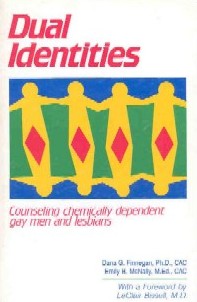
Dr. Dana Finnegan, one of the co-authors of Dual Identities: Counseling Chemically Dependent Gay Men and Lesbians, has her PhD in English literature; hardly a credential for writing this book. However, because she is also a Certified Alcoholism Counselor, one of the founding members of the National Association of Lesbian and Gay Alcoholism Professionals, a well respected presenter, and author of other publications on addiction, she is a credible author for Dual Identities.
A Bit of Trivia
My first book was The NALGAP Annotated Bibliography: Lesbians, Gay Men, and Substance Abuse. Dr. Dana Finnegan and Dr. Emily McNally, the authors of Dual Identities were my co-authors for this book.