Construct a Star Diagram:
Generate Ideas
At this point, you might be asking "What does the Star Diagram have to do with getting ideas for a topic?" That is a fair question which is answered in this step.
It is best if you can somehow relate to your topic; to select a topic that has meaning for you. One way to do that is to begin by thinking of various topics and then considering whether or not they are interesting. Another way is to begin with your interests and then apply those to the topic. This is the basis of the star diagram.
Based on your interests, what are potential research topics about which you would like to write? At this point, don't worry about the course topic. Just come up with your list.
Once your list is finished, you can make modifications to your list. For example, World War II battles might be a topic that interests you. Yet this topic would not be appropriate for an Ancient World History course. But, your interest in World War II suggests that you might be interested in battles fought in the ancient world.
Some people might want to skip the intermediary step by just asking how their interests relate to the topic. That is what I did to generate the list below; topics that assumed I had to write a paper on the Middle East. For example, I listed my parents on the star diagram. At the time, they were in Arizona. Arizona has deserts and the Middle East has deserts. Comparing the American to Middle East deserts is a potential topic.
Brainstorming Rule: Don't Eliminate Ideas
As you brainstorm, write down everything. This is not the time to eliminate ideas.
I included many potential topics on which list even though I had absolutely no interest in pursuing them. My job was to generate a list of potential topics from which I could eventually select a topic.
Results of Brainstorming
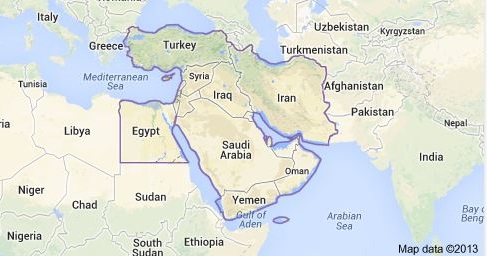
The Schoolcraft College International Institute selects one geographic area each year on which to focus. In this example, the brainstorming list assumed that the assignment was to come up with a topic for the Middle East. However, a similar process could be used for any geographic area or any topic.
In about five minutes, by looking at my diagram, I came up with many potential topics for a potential paper on the Middle East. Because some of the topics are obviously too broad, I could generate more ideas as I refine them.
Some of the topics on the list might not fit the course requirements. Others might have to be eliminated because I do not have sufficient time to do enough research. And others will be eliminated because of lack of interest. However, because I took the time to do the Star Diagram, I will have quality topics from which to choose.
- Holiday celebrations in the Middle East. Halloween? Christmas? Islamic celebrations?
- How are birthdays celebrated?
- What is the role of the teacher in ___________ country? Might look at several? Compare? Focus on one?
- What is is like to build a new legislative process if Afghanistan/Iraq? Differences? Similarities?
- What does it mean to have an Islamic nation?
- What types of agriculture are available?
- What is the history of the hanging gardens?
- How does one teach at a bombed out university?
- What are the educational opportunities for women?
- What types of agriculture are there?
- Specific poet or author to study?
- What about the woman who just won the Nobel Peace Prize? (No disrespect was intended, but Dr. Berg could not remember her name and during brainstorming is not the time to look things up.)
- Hanging gardens of Babylon?
- What are family relations like? Marriage? Co-habitation before marriage? Same sex couples?
- What are views on homosexuality?
- Study an artist? Type of art?
- Because there is so much history in the region, it is hard to know where to begin?
- What is the fertile crescent?
- Why do we have a Red Cross and a Red Crescent? Similarities? Differences? History?
- What psychological impact with the December 2003 Iranian earthquake have on that country? the region?
- What role are international agencies playing in the region?
- What is the government run in _________ country? Pick one? Compare to United States? Pick two and compare?
- Maybe write a profile of a politician? religious leader?
- What role do pets play in the culture?
- How is alcoholism viewed? Treated? (Dr. Berg's dissertation was on Alcoholics Anonymous.)
- Is the myth that Jews are culturally immune to addition found in Israel? AA in Israel? another country?
- What are death rituals?